
Building Resilience in Postindustrial Pennsylvania: The Power of Community-Led Change
Reflections from the Green Building Alliance’s Un-Panel & Collaborative Dinner in Hazelwood, Pittsburgh
What does resilience look like in a postindustrial community? Is it energy-efficient housing, accessible transportation, or investments in public infrastructure? Or does it begin with something less tangible: the determination of residents to come together, identify shared challenges, and build a better future for their communities?
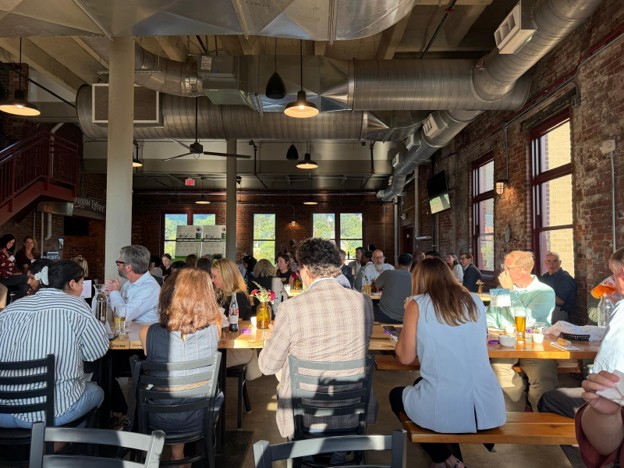
At GBA’s Building Resilience in Postindustrial PA: Un-Panel & Collaborative Dinner on September 14, community leaders from across Pennsylvania offered a compelling answer. Hosted at Hazelwood Brew House in Pittsburgh, the gathering brought together practitioners and local leaders for an evening of conversation about the relationship between community-driven change and the built environment.
Moderated by Jenna Cramer of Green Building Alliance, the discussion featured Pastor Tim Smith of Center of Life in Hazelwood, Bethany Ayers-Fisher of the City of Reading, Julie Wilson of Common Roots in Meadville, and Megan Tuñon of Etna Community Organization. Rather than approaching resilience as an abstract planning concept, the speakers shared perspectives shaped by their work, their communities, and the people they serve.
The result was a conversation that placed people at the center of resilience.
Resilience Begins with the People Who Call a Place Home
One of the evening’s most powerful ideas was that communities are not simply recipients of change. They are capable of identifying their own needs, mobilizing their own resources, and creating solutions that reflect their lived experiences.
Pastor Tim Smith described Hazelwood as a place where every resident has something to contribute – a kind of “University of Hazelwood,” where the knowledge and experiences of community members are themselves valuable resources. For him, resilience means recognizing what a community needs, bringing people together, and finding ways to restore or create opportunities that may have been missing.
He also emphasized the importance of expanding access to education and resources for future generations. His perspective reframed resilience as more than the ability to recover from hardship. It is also the ability to create the conditions for the next generation to thrive.
As Pastor Smith put it, resilience is about recognizing that things are happening for a community, rather than simply happening to it.
That distinction is significant. Too often, communities experiencing economic or industrial decline are described through the challenges they face. A community-centered approach shifts the focus toward the agency, knowledge, and potential that already exist within those places.
Turning Community Strength into Tangible Change
Across the discussion, speakers described different ways that local leadership and collective action are translating into tangible improvements.
Julie Wilson, Executive Director of Common Roots in Meadville, spoke about the sense of community that emerges when people work together. She highlighted the brilliance of ordinary people and the energy that comes from collective action. Her work also illustrates how community resilience can translate into practical housing solutions, including efforts to develop beautiful, energy-efficient homes at an attainable price point of approximately $50,000. Common Roots is currently working toward completing a pilot cottage through its housing efforts.
This example connects two important dimensions of resilience: creating places where people can afford to live and ensuring those places are efficient, healthy, and sustainable. Energy-efficient housing is not only an environmental intervention; when made accessible, it can also support household stability and expand opportunities for residents.
In Etna, Megan Tuñon of Etna Community Organization described resilience as a shift away from a sense of powerlessness toward taking challenges into the community’s own hands. She characterized Etna as small but mighty – a community where residents and volunteers come together to solve problems despite limited capacity.
Tuñon highlighted the borough’s energy-efficiency planning efforts and the importance of creating spaces where people can connect. At the time of the discussion, Etna’s Center of Community was nearing its anticipated opening. Envisioned as a third space beyond home and work, the center would provide a place for residents to gather, build relationships, and strengthen their sense of belonging.
The need for such spaces is especially important in a community where, as Tuñon noted, approximately 25% of residents do not have internet access. Access to information, services, and opportunities increasingly depends on connectivity, making community spaces valuable not only for social interaction but also for inclusion.
Together, these examples demonstrate that resilience does not look the same everywhere. It might mean creating affordable, energy-efficient housing, establishing a welcoming gathering space, improving access to resources, or giving residents greater ownership over the decisions that affect their lives.
The Built Environment as a Tool for Community Empowerment
The conversation also raised an important question: How can the built environment better support the people working to strengthen their communities?
Sustainable buildings and infrastructure are essential, but their impact depends on how effectively they respond to local priorities. A well-designed building, for instance, can do more than reduce energy consumption. It can provide a space for education, strengthen social connections, or support a community organization’s long-term work.
Similarly, investments in transportation infrastructure can expand access to jobs, schools, services, and recreation. When asked to envision their communities ten years into the future, speakers described ambitions that extended well beyond individual projects.
Bethany Ayers-Fisher, Sustainability Manager in the City of Reading’s Public Works Department, spoke about a future with more bike trails and bike lanes and fewer cars. Her vision points toward a transportation network that gives residents more choices in how they move through their city.
In Etna, Tuñon envisioned a more vibrant community, educational success for children, an extended Allegheny River Trail, and a future in which Etna and similar towns are thriving again. She also emphasized the importance of the next generation stepping into leadership and sustaining that progress.
For Pastor Smith, the future meant seeing Center of Life continue to grow and prosper, while ensuring that the people leading and supporting the organization today could continue their work for years to come.
These visions differ in scale and focus, but they share a common thread: the goal is not simply to improve places physically. It is to create places where people can build relationships, access opportunities, participate in community life, and imagine a future for themselves and their families.
Resilience Requires More Than Vision
If community determination is the starting point, what does it take to turn that determination into lasting change?
One of the evening’s most revealing questions asked the speakers what they would need to do what they do best for their communities.
Their responses highlighted a challenge familiar to many community-based organizations: the gap between the work people are capable of doing and the resources available to support it.
Funding and sustained stewardship emerged as important needs. Wilson emphasized the role of stewardship alongside the financial resources required to make projects possible. Tuñon described the limitations of working within a small governmental structure, with limited staff capacity and significant reliance on volunteers. She expressed the need for resources that would allow people to contribute more consistently, rather than having to fit essential community work around other responsibilities.
Pastor Smith also spoke to the demands of raising money and sustaining community efforts.
These reflections are a reminder that community-led resilience cannot depend indefinitely on goodwill and volunteer labor alone. Residents and local organizations may bring deep knowledge, commitment, and creativity to their work, but they also need the funding, staffing, partnerships, and institutional support to turn ideas into durable outcomes.
For planners, designers, policymakers, and organizations working in the green building sector, this is an important consideration. Supporting resilience means looking beyond the delivery of a project to the capacity required to maintain it, program it, and ensure that it continues to serve the community over time.
Looking Ahead: Building Futures, Not Just Infrastructure
The evening’s discussion offered a broader understanding of what it means to build resilience in postindustrial Pennsylvania.
Resilience is visible in energy-efficient homes, connected trails, accessible public spaces, and community facilities. But it is equally visible in residents organizing around shared priorities, local leaders creating opportunities for children, and organizations working to ensure that future generations can continue the progress made today.
Perhaps the most important takeaway was that communities already possess many of the ingredients needed to create change. The challenge is to recognize those strengths and provide the conditions in which they can grow.
As practitioners in the built environment, we have an opportunity and a responsibility to listen to the people who know their communities best. That means approaching projects with curiosity rather than assumptions, recognizing community knowledge as a form of expertise, and aligning investments with locally defined needs and aspirations.
Ultimately, resilience is not something that can be designed and delivered to a community. It is something communities build themselves, with the right relationships, resources, and tools to support them.
The question for those of us working toward a healthier, greener, and more equitable built environment is how we can help make that work possible.