
Cohesive Planning for a Resilient Region: Aligning Pittsburgh and Allegheny County’s Visions
Reflections from the Green Building Alliance’s Resilient & Healthy Spaces Week
Resilience challenges rarely stop at municipal boundaries. Transportation networks, natural systems, land use, and community priorities connect cities to the broader regions around them, making coordination across jurisdictions an important part of long-term planning.
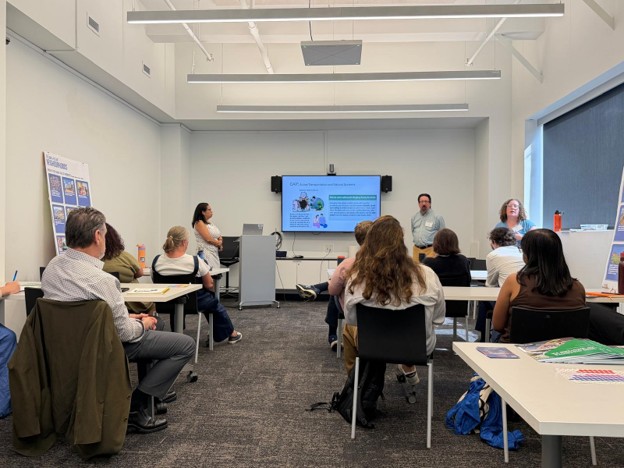
On September 16, during the Green Building Alliance’s Resilient & Healthy Spaces Week, planners and practitioners gathered at the Carnegie Library of Pittsburgh – Downtown for Cohesive Planning for a Resilient Region with Allegheny County & The City of Pittsburgh.
The session featured Chris Cieslak of Green Building Alliance, Ivette Mongalo-Winston and Flore Marion of the City of Pittsburgh, and Brittany Prischak and Matt Trepal of Allegheny County. The presenters discussed regional planning efforts, comparing the plans’ timelines, progress, and implementation challenges.
Connecting City and County Priorities
A central theme of the discussion was the importance of aligning planning strategies and focus areas at both the county and city scales. Although each jurisdiction has its own responsibilities and priorities, their planning efforts intersect in areas that shape residents’ everyday lives.
The presentations illustrated this relationship through geographic planning maps and discussions of active transportation and natural systems. These topics highlight how decisions about mobility, land use, and the environment can extend beyond individual neighborhoods or municipal boundaries.
Coordinating planning efforts provides an opportunity to identify shared goals, reduce disconnects between strategies, and better understand how local initiatives contribute to broader regional outcomes.
From Plans to Implementation
The presenters also compared where their respective planning efforts stood in their timelines and discussed the challenges involved in moving them forward. This offered a practical perspective on the complexity of regional planning: developing a vision is only one step, while coordinating agencies, engaging stakeholders, and translating priorities into action requires sustained effort.
The session’s emphasis on incorporating the perspectives of residents, businesses, developers, and other stakeholders was an important reminder that effective planning must connect institutional goals with the needs of the people who experience their outcomes.
A More Resilient Region Through Collaboration
For professionals working in urban planning and the built environment, the session reinforced the value of looking beyond jurisdictional boundaries. City and county plans may serve different purposes, but their combined impact depends in part on how well their strategies complement one another.
Ultimately, cohesive planning is about more than aligning documents. It is about building connections between agencies, places, and community priorities so that individual efforts can contribute to a shared vision for regional resilience.
As Pittsburgh and Allegheny County continue their planning work, coordination across scales remains an important opportunity to support a region that is better connected, more sustainable, and responsive to the people who call it home.