In 2023, GBA’s 2030 team conducted an analysis on potential savings for two of Gannon University’s buildings. Recognizing that colleges, universities and schools have a several-month period during which occupancy levels in their buildings are significantly reduced, the analysis highlighted data on energy reductions experienced in other college/university buildings during the 2020 COVID shutdown.
Upon review of the report, Gannon used these numbers as a jumping starting point to develop and implement an energy savings plan.
With much of the student population away from campus during the season, Gannon was able to consolidate summer classes into two buildings, leaving many of their other buildings predominantly unoccupied. And because unoccupied spaces do not require the same level of conditioning, Gannon raised the temperature setpoint in unused spaces to 78°. Additional savings resulted from reduced lighting demand and lower hot water loads.
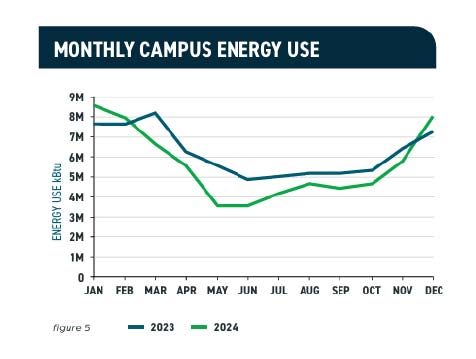
The effects of these changes are immediately apparent when looking at Gannon’s energy use by month (as shown).
“As a Catholic university, Gannon is deeply invested in the values of Laudato Si’ and our responsibility to care for creation. Our participation in the 2030 District reflects this commitment to building a more sustainable campus and protecting our common home. By centralizing summer classes and adjusting building temperatures, we not only reduced utility use and saved nearly $93,000 but also created more consistent operations that streamline maintenance and cut costs. These efforts show how faith-inspired commitments can translate into tangible action for our community and for the Earth.”
Gannon University
On average, much of 2024 was warmer than 2023, which, while naturally reducing heating needs during the spring and fall, also resulted in increased cooling needs during the summer. It would be expected that the 2024 energy use during the summer would be higher than the 2023 energy given the increased outdoor temperatures; however, Gannon’s energy graph shows the opposite. In May 2024, Gannon’s campus energy use fell by 36% compared to the prior year.
Energy use over the rest of the summer tells a similar story: • 26% decrease in June • 18% decrease in July • 11% decrease in August
This reduction in energy use resulted in $93,000 savings in utility and operations costs over the course of the summer.
It is common for right-sizing strategies to be overlooked in favor of capital expenditures and large-scale project installations due to their comparatively low visibility to building end users. Gannon’s success shows that energy savings can be unlocked with relatively simple operational and scheduling optimizations that adapt consumption to meet need.