
Heat Pumps
Heat pumps are a heating and cooling technology that uses environmental temperatures to provide thermal comfort.
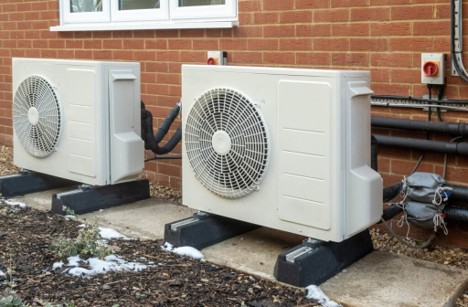
Unlike air conditioning, space heating is traditionally supplied by the burning of fossil fuels, most commonly natural gas. Not only can the cost associated be expensive, but the procurement and use of fossil fuels have numerous negative consequences for the environment.
A solution to this problem lies in heat pumps. Unlike furnaces and boilers, heat pumps do not require a fuel source; rather, they use the refrigeration cycle to move heat from one space to another, generally from outside air to the inside of a building. Unlike their cousins, air conditioners and refrigerators, heat pumps are reversible, which allows them to provide heating in the winter and cooling in the summer.
Heat pumps are not a new technology; they have been around for over 150 years. Heat pumps in the US gained popularity during the oil crisis of the 1970s, and while the concept remains the same, the technology has improved markedly since then, making heat pumps a viable electric space heating option.
How Heat Pumps Work
Heat pumps use the vapor-compression refrigeration cycle and low boiling point refrigerants to move heat. As the refrigerant flows through the cycle, it absorbs heat from a heat source and rejects heat to a heat sink.
Since heat pumps are reversible, in heating months the source is the outdoor environment, bringing heat into the building, while in cooling months they draw heat from inside and reject it to the outdoor environment.
The vapor-compressions refrigeration cycle operates in a simple process:
- Ambient air is blown over the evaporator heat exchanger filled with cool refrigerant, which heats up and evaporates.
- The refrigerant enters a compressor, which compresses the gaseous refrigerant, further increasing its temperature.
- The refrigerant flows through the condenser heat exchanger, which transfers the heat to the surrounding air and condenses the refrigerant back into a liquid.
- The refrigerant enters an expansion valve, which lowers its pressure, cooling the refrigerant back down to its starting temperature.
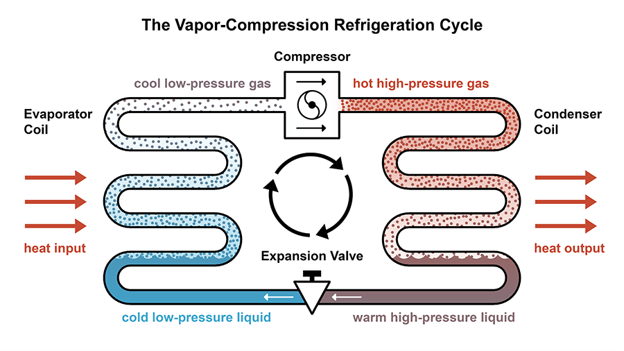
Source: Vapor-Compression Refrigeration Cycle | Building Enclosure
Types of Heat Pumps
There are two main types of heat pumps: air source and ground source.
Air Source Heat Pumps
Air source heat pumps (ASHPs) utilize outdoor air as the heat source or heat sink. They generally have a COP (coefficient of performance) of 2-4, meaning that for every unit of electricity supplied to the unit, 2-4 units of heat are emitted. The downside of ASHPs is that their efficiency is tied to the outdoor temperature. As the temperature drops, so does the unit’s efficiency. Most ASHPs experience this around 32°F, but there are cold weather models that can operate efficiently in temperatures down to -15°F. ASHPs have around a 15-year life expectancy, depending on the model.
There are two subtypes of ASHPs:
- Air-to-air heat pumps supply heat directly to indoor air via a forced-air ducted system or from individual ductless units (mini-splits).
- Air-to-water heat pumps supply heat to an indoor water system and deliver it via radiators or underfloor heating. If radiators are used, they generally must be larger since heat pumps supply lower water temperatures than furnaces and boilers. For this reason, underfloor heating works well with heat pumps. Air-to-water heat pumps can also provide domestic hot water.
Ground Source (Geothermal) Heat Pumps
Ground source (geothermal) heat pumps (GSHPs/GHPs) utilize the ground as the heat source or heat sink. Ground temperatures fluctuate less than air temperatures, so GSHPs are more efficient in colder weather than ASHPs.
GSHPs generally have a COP of 3-5 and can maintain these high efficiencies in colder temperatures. The heat pump has a 20-year lifespan, much like an ASHP, and the underground piping can last 50-100 years before replacement. The underground piping increases the cost of the system, making GSHPs more expensive than ASHPs.
Like ASHPs, GSHPs also have two use types, liquid-to-air and liquid-to-water and can be used in many of the same capacities.
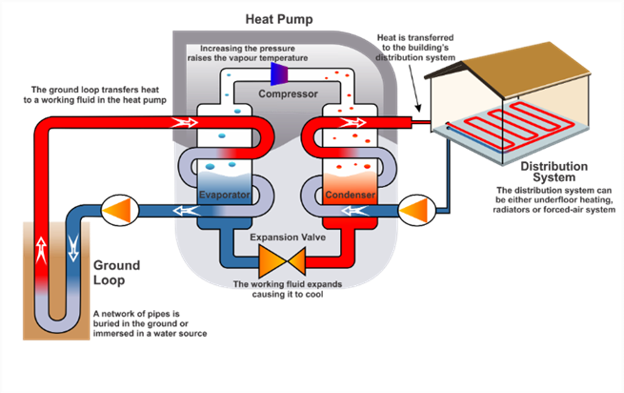
Source: Greenmatch
Ground Source Heat Pumps use underground heat exchangers to source or dissipate heat. There are multiple different arrangements of these heat exchangers:
Horizontal Closed Loop
Pipes are buried in ~4ft deep trenches in looped or straight alignment. They require a large amount of land.
Vertical Closed Loop
Small boreholes are drilled up to 500 feet and contain two pipes. Installation requires a special drilling machine. This system is more space-efficient and doesn’t need as much piping since temperatures deeper underground are more stable.
Closed Loop Water Source
A looped collector is placed underneath a water surface. The water body must be deep enough to avoid freezing during the winter.
Open Loop Water Source
This system circulates well or surface water instead of refrigerants. These systems are less common than closed loop systems and must comply with more environmental regulations since system water discharges into local water sources.
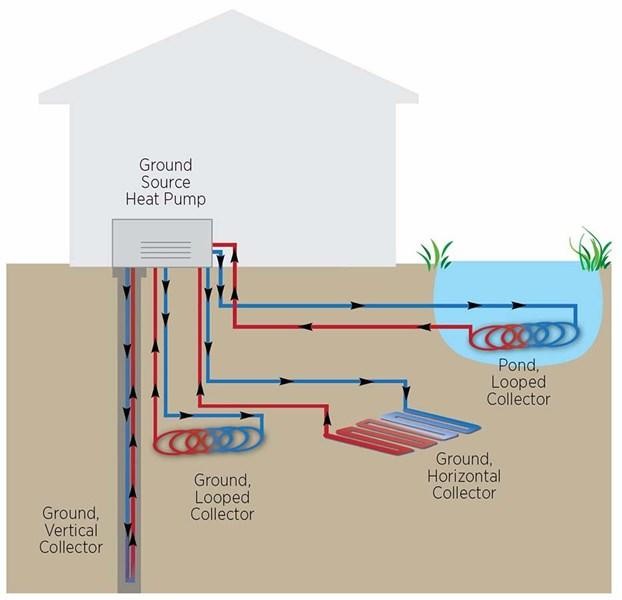
Source: Carolina Country
Comparing ASHP and GSHP
|
|
Air Source Heat Pumps |
Ground Source Heat Pumps |
|---|---|---|
|
Installation |
Low space requirement, simple installation process |
High space requirement, complex installation process due to drilling/digging requirement |
|
Cost | ||
|
Average COP |
2 – 4 |
3 – 5 |
|
Seasonal Variance |
Weather and climate dependent, performance can vary throughout the year |
More consistent performance year-round |
|
Life Expectancy |
15 – 20 years |
20 – 25 years |
Advantages of Heat Pumps
Green Energy
Heat pumps are the cleanest way of providing heating and cooling to buildings, especially as grid generation becomes cleaner.
Safer
Heat pumps do not require gas lines or fuel storage, making them safer than furnaces and boilers.
High Efficiency
Heat pumps are very efficient, with an average COP of 3, much higher than electric resistance, which has a maximum efficiency of 100%, and fossil fuel heating, which generally have efficiencies of 80-95%. This can deliver significant energy cost savings.
Dual Modes
Heat pumps can provide both heating and cooling to buildings, making them more space efficient and less complex than other types of HVAC system.
Things to Consider
Higher Installation Costs
Heat pump systems, especially GSHPs, have higher up-front costs than traditional HVAC systems; however, there are a number of programs that offer subsidies and other incentives for installation.
Temperature Dependence
ASHP efficiency is tied directly to outdoor temperatures, decreasing in efficiency when temperatures are at their most extreme, when heating and cooling is most important.
Ground Temperature Degradation
There are concerns about the long-term thermal degradation of geothermal systems in climates that have an imbalance in heating and cooling loads. GSHPs in locations with significantly more cooling demand, such as tropical and subtropical regions have suffered from gradual underground heat buildup that reduces system efficiency. Similarly, GSHPs in cold climates, which have significantly more heating demand, have seen progressively decreasing underground temperatures that reduce system efficiency. Research is underway on ways to mitigate these problems, but one potential solution for colder climates is to pump heated water from solar thermal arrays back underground during the summer.
Case Study

Frick Environmental Center
The Frick Environmental Center is the world’s first publicly accessible, free admission Living Building Challenge project. It incorporates a host of sustainable design features and is not only certified by the Living Building Challenge but is also a Net-Zero Energy building and has a LEED Platinum rating. The building uses ground source heat pumps with deep wells to provide heating and cooling for the building, with a consistent underground temperature of 50F.